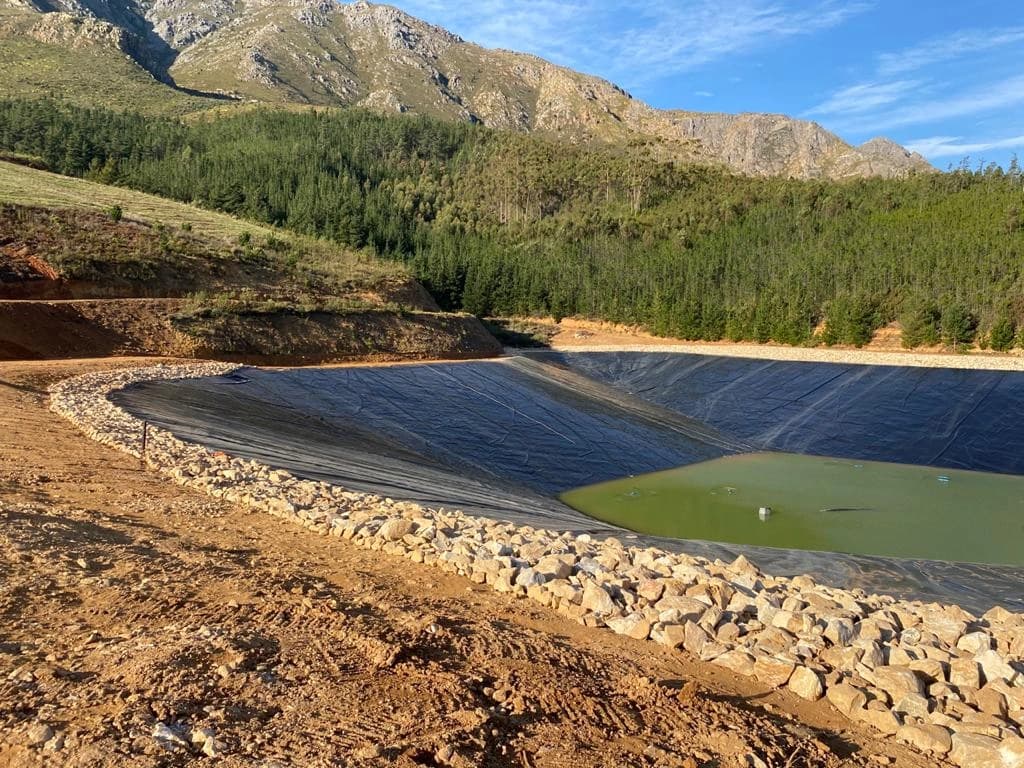
A farm dam is often the largest capital asset on a property after land itself — yet many remain unlined on soils that were never watertight. South African producers face municipal cost pressure, load-shedding that stops borehole pumps mid-irrigation, and drought cycles that make every megalitre in January worth more than the same megalitre in June. Lining is how you keep winter rain and borehole top-up available for cattle, pivots and packhouses without rebuilding the entire embankment.
No single climate applies nationally. Summer-rainfall maize areas lose water to seepage before autumn planting moisture is secured. Winter-rainfall Cape farms bank licensed winter inflow for six dry months. Bushveld properties see evaporation and wildlife traffic simultaneously. Liner spec must match sun exposure, frost risk at altitude, and whether the dam dries completely each year or holds a permanent pool.
Karoo shale weathers into fissured beds that seep along planes. Highveld clay swells when wet and cracks when dry — anchor trenches need detail that allows slight movement without tearing HDPE. Bushveld sands drain within hours of a storm if unlined. Laterite and ironstone gravels puncture thin liners without geotextile protection. A farm dam lining is only as good as the subgrade and anchor design behind it.
Centre pivots draw dam levels down fast during heatwaves — farmers notice seepage as inability to complete a full circle rather than as a visible leak. Drip and micro systems need cleaner water than muddy seepage dams provide; lining plus basic silt control improves emitter life. Orchard blocks scheduled around flowering cannot pause because the dam failed to hold spring top-up from boreholes.
Commercial grain, fruit, sugar and livestock enterprises line primary irrigation dams. Game farmers line drinking dams for antelope and cattle with fencing and batter protection. Smallholders with a single earth dam often see the fastest payback because one asset serves house, tunnel and stock. Dairies and piggeries link lined farm dams to backup steel tanks near parlours.
Farm dam linings reduce the largest avoidable loss after evaporation on porous soils. Many clients pair a lined earth dam with a steel reservoir near the homestead for household and critical stock water. Damtech quotes HDPE for large catchments, PVC for ponds and tanks, and bitumen where an old cement farm dam still has sound walls.
HDPE lining for large farm earth dams
PVC for ponds, turkey nests and small reservoirs
Bitumen torch-on for cement farm dams
Leak survey, patch welding and crest repairs