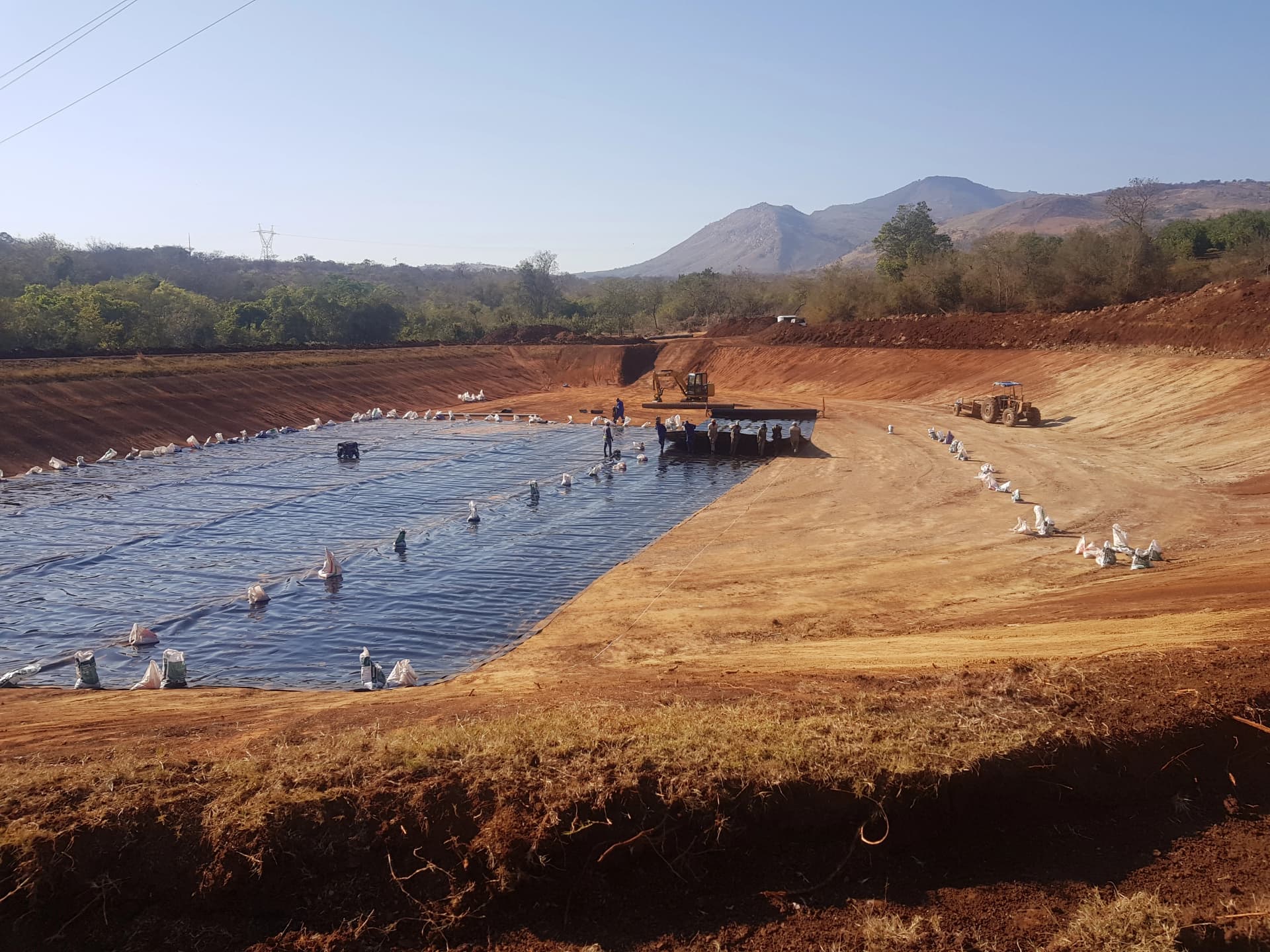
Pretoria sits on the Highveld at roughly 1,300 m elevation — a city where thunderstorms can dump summer rain in hours, yet winter days stay dry for weeks. That pattern favours farm dams and estate ponds as storage, but iron-rich soils around Bronkhorstspruit and clay-loam belts near the Apies catchment often seep unless lined. Peri-urban smallholdings along the N1 and R21 corridor increasingly rely on boreholes with municipal supply as backup, which makes on-site retention a practical priority rather than an optional upgrade.
Tshwane receives most rainfall between October and March, with frequent afternoon convection and hail risk on exposed embankments. Mean annual precipitation is moderate by national standards, but evaporation on open dams remains significant through hot September and October before the rains. Frost is occasional on low-lying paddocks west of the city, which can stress unprotected outlet pipes and floating intake lines if not planned during installation.
North and east of Pretoria, reddish-brown Hutton-derived soils and shallow clay over weathered granite are common on smallholdings. These soils shrink and swell seasonally — liner anchor trenches must accommodate slight ground movement without stressing HDPE at the crest. Rocky quartzite outcrops appear on ridges around the Magaliesberg fringe; there geotextile underlay and careful benching before liner deployment are standard Damtech practice.
Centre-pivot and hose-irrigation blocks on maize, vegetables and turf farms west of Pretoria need dependable summer reserves when borehole yield dips. Estate landscaping and equestrian properties irrigate from balancing dams that must hold water between municipal restriction periods. Where electricity is interrupted, stored volume — not instantaneous pump rate — determines whether irrigation schedules survive load-shedding.
Agriculture on the city fringe includes mixed livestock, hay production and emerging berry tunnels. Game breeding and wildlife estates north of Pretoria line drinking dams for eland, wildebeest and cattle. Commercial clients include nurseries, light industrial yards with dust-suppression needs, and schools or lodges with fire-water reserves. Mining is less dominant here than on the West Rand, but quarry and borrow-pit water management still appears on the urban edge.
Clients typically need to capture storm runoff in earth dams, retain borehole water through dry winters, and reduce dependence on Rand Water restrictions. HDPE lining stops seepage through porous embankments; corrugated steel tanks suit tight sites where a dam footprint is impossible. Concrete reservoir waterproofing protects stored water quality where tanks or canals feed irrigation networks.
HDPE and PVC dam lining supply and installation
Corrugated steel tanks for compact peri-urban sites
Bitumen waterproofing for concrete reservoirs and slab roofs
Leak detection, patch repair and crest anchor refurbishment