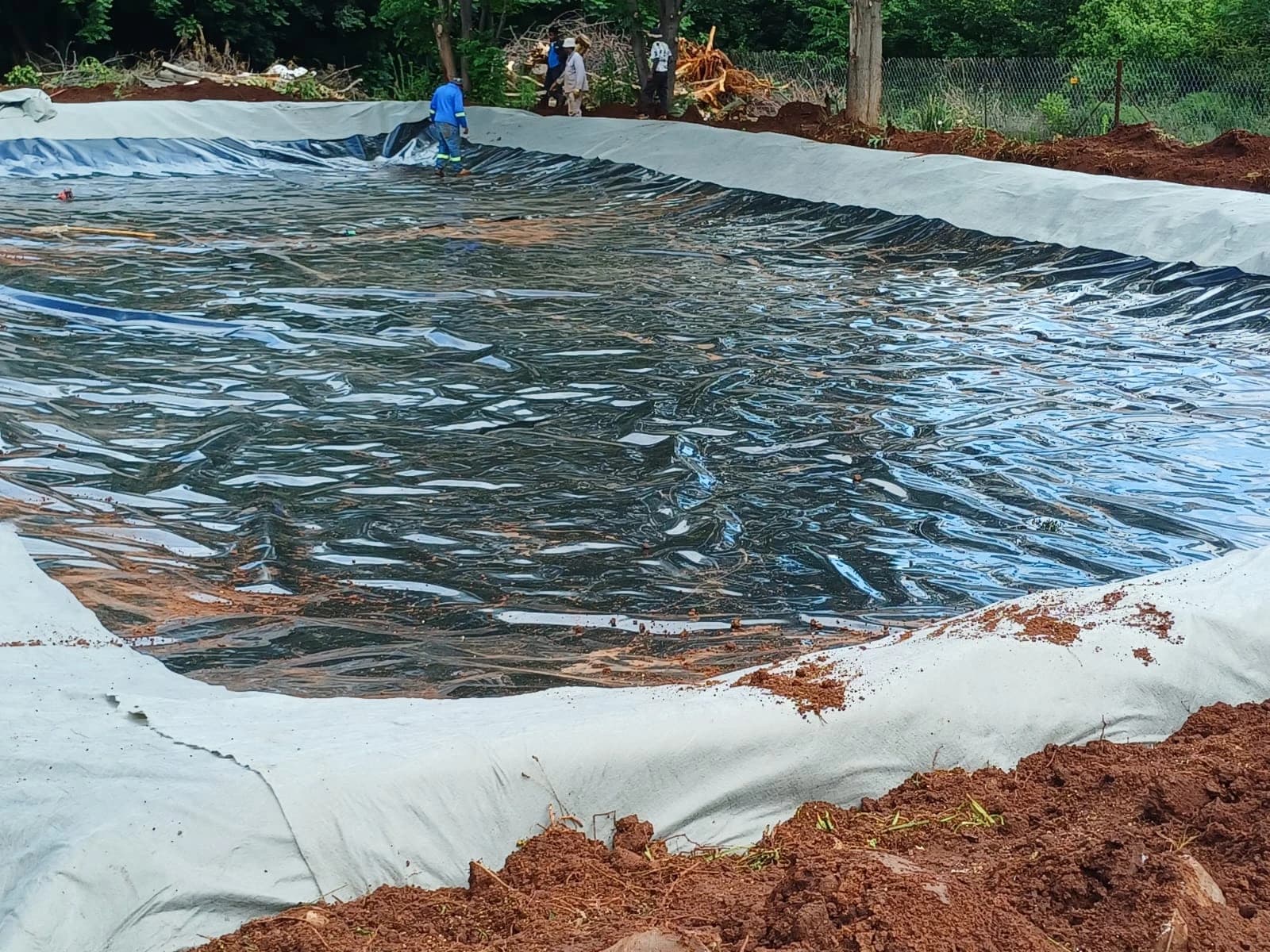
In South Africa’s driest province, every pumped or allocated cubic metre counts. Damtech quotes and installs liners for balancing dams, stock reservoirs and mine ponds in the Northern Cape.
The Northern Cape is South Africa’s largest and driest province: the Karoo, Namaqualand and the Kalahari cover most of it, and towns are far apart. Yet a ribbon of intensive irrigation follows the Orange River through Upington, Keimoes, Kakamas and Groblershoop, and the Vaal and Riet rivers feed farms around Douglas, Jan Kempdorp and Hartswater. Away from the rivers, sheep and cattle farms depend on boreholes, windmills and reservoirs. Mining towns such as Kathu, Hotazel, Kimberley and Aggeneys add large industrial water demands. In a landscape this dry, water lost to seepage is rarely replaced by rain, so lining is about protecting every cubic metre that has been pumped or allocated.
LOCAL CONDITIONS
Climate & Seasonal Rainfall
Most of the province receives little rain, and what falls is unreliable. The east and the Kalahari get summer thunderstorms, while Namaqualand on the west coast receives its rain in winter. Summers are very hot, with long, cloudless days that drive some of the highest evaporation rates in the country; an open dam can lose a significant depth of water to the air alone. Winters bring cold, clear nights and frost inland. Wind adds to evaporation and can lift poorly anchored liner edges, so anchor trench design and ballast at the crest deserve attention. Multi-year droughts are a normal part of farming here, not an exception, so storage is best planned around a bad year.
SITE FACTORS
Soils & Ground Conditions
Shallow soils over calcrete or hard rock are common, along with deep, loose Kalahari sands that hold almost no water on their own. River terraces along the Orange and Vaal have deeper alluvial soils, but these are often sandy or silty and seep readily. Some soils are saline or sodic, which can make clay disperse and erode when wet. Karoo areas have shale and dolerite with sharp, broken stone near the surface. Preparing a smooth, compacted subgrade — removing rock and adding a geotextile underlay where needed — is often the most important step before an HDPE or PVC liner is placed.
WATER USE
Irrigation & On-Farm Water Use
Along the Orange River, table grapes, raisin grapes, wine grapes, dates, pecans and lucerne are grown under drip and micro-irrigation. Farms draw water from canals and the river under allocations, and many pump into balancing dams so they can irrigate on their own schedule. The Vaalharts scheme around Jan Kempdorp and Hartswater, and the Douglas area, grow lucerne, pecans, maize, groundnuts and wheat, often under centre pivots. In these systems a balancing dam that leaks means losing allocated water before it reaches the crop, and on sandy river soils that loss can be substantial over a season.
SECTORS
Agriculture, Mining & Industry
Irrigated horticulture and lucerne along the rivers, extensive sheep and goat farming in the Karoo and Namaqualand, and beef cattle and game in the Kalahari make up the agricultural picture. Mining is a major part of the economy: iron ore around Kathu and Postmasburg, manganese in the Kalahari field near Hotazel, diamonds historically centred on Kimberley and the west coast, and base metals at Aggeneys. Mines and their contractors need process water, return water and stormwater storage. Solar energy projects have also grown in the province, and construction camps and maintenance yards need dependable stored water. Farmsteads far from municipal supply also rely on their own reservoirs for household water, which makes a dependable, leak-free store a basic necessity rather than a luxury.
STORAGE
Water Storage Needs
Common needs are balancing dams on irrigation farms, stock-water reservoirs fed by boreholes and windmills, and lined containment for mine and process water. Because evaporation is so high, owners often weigh up dam depth and surface area, or whether a roofed steel tank suits a smaller volume better. HDPE is the usual choice for large earth dams and mine ponds, with thickness chosen per site; PVC can suit smaller ponds; and corrugated steel tanks and livestock troughs suit stock posts far from the homestead. Damtech quotes and installs across South Africa, including the Northern Cape. Remote sites need delivery and access planned up front, and costs depend on size, material and site preparation, as our dam lining cost guide explains.
WHERE LINERS ARE USED
Typical Local Uses
Balancing dams for Orange River vineyards and raisin farms
Pivot irrigation storage in the Vaalharts and Douglas areas
Borehole-fed stock-water reservoirs on Karoo and Kalahari farms
Process and return-water dams at iron ore and manganese mines
Wildlife water points on Kalahari game farms
LOCAL SERVICES
Damtech Services in This Area
HDPE lining for balancing and irrigation dams
HDPE containment for mine process and return water
Corrugated steel tanks and livestock troughs for stock posts
Leak repair on existing dams and reservoirs
NEXT STEPS
Plan Your Dam Liner
HDPE dam lining for large earth dams, mine and effluent dams.
Damtech dam lining and water storage installations.
FAQ
Frequently Asked Questions
How do I reduce evaporation as well as seepage in the Northern Cape?
Lining stops seepage but not evaporation. A deeper dam with a smaller surface area loses less to the air, and for smaller volumes a roofed steel tank can help. We can discuss the options when you share your storage needs.
Can you line a balancing dam that is filled from an irrigation canal?
Yes. Balancing dams on canal schemes are commonly lined with HDPE. Plan the work for a period when the dam can be emptied, and share inlet and outlet details so pipe penetrations can be sealed properly.
Do saline or sandy soils affect dam lining?
They affect preparation more than the liner itself. Loose sand must be compacted, dispersive or saline clays assessed, and stones removed or covered with geotextile before the liner goes down.
Do you quote for remote farms and mines in the Northern Cape?
Yes. Damtech quotes across South Africa, including remote Northern Cape sites. Include the location, road access and dam dimensions so delivery and installation can be planned.
MORE REGIONS
Explore Further
Regional dam lining and water storage information for other parts of South Africa.