Damtech guide
Steel Water Tank Base: Sand Pad, Ring Beam or Concrete Slab?
The base under a steel water tank decides how long the tank lasts. A good base keeps the liner flat, the bottom of the wall dry and the tank level for decades. A poor base lets the edge wash away, the floor sink and the wall rust at ground level.
There are three main options for a steel water tank base: a compacted sand or crusher-dust pad, a concrete ring beam, or a full concrete slab. This guide explains each one in plain language, with the pros and cons, and helps you choose the right one for your tank and your ground.
Quick answer: which water tank base do I need?
- Small tank (up to about 6 m wide) on firm, level ground: a compacted sand or crusher-dust pad is usually enough.
- Bigger tank (about 6 m wide and up), a tank with a roof in a windy spot, a sloping site or sandy ground: use a concrete ring beam.
- Problem ground (dolomite or clay that swells), drinking water or fire water, or a tank close to a house: use a concrete slab designed for the site.
Not sure? Send us a few photos of the site and we will tell you which base fits.
Already know which base you want? See how big each base should be for your tank size.
Why the base matters so much
Most of our corrugated steel tanks have no steel floor. A strong PVC liner holds the water. It lies on a protective floor sheet on top of the base and runs up the inside of the steel wall.
That means the base is the floor of your tank. Everything under the liner must be smooth, firm and level.
The weight itself is not the big problem. The deeper the water, the more it presses down, but even a full tank puts only a few tonnes on each square metre:
| Tank height (full) | Weight on each square metre of base |
|---|---|
| 1.55 m (two rings) | About 1.5 tonnes |
| 2.3 m (three rings) | About 2.3 tonnes |
| 3.05 m (four rings) | About 3 tonnes |
The width of the tank does not change these figures. A wider tank simply covers more ground, so there is more room for the soil to vary from one side to the other.
Most firm, compacted ground can carry that. What really damages a tank is:
- A soft edge that sinks or spreads under the wall.
- A floor that sinks in the middle or tilts, which stretches the liner and pulls the wall out of round.
- Rain or overflow washing the base away at the edge.
- Soil, water or plants against the bottom of the wall, which makes the steel rust there first.
- Stones or sharp edges under the liner, which can puncture it.
A good base solves all five.
Option 1: compacted sand or crusher-dust pad
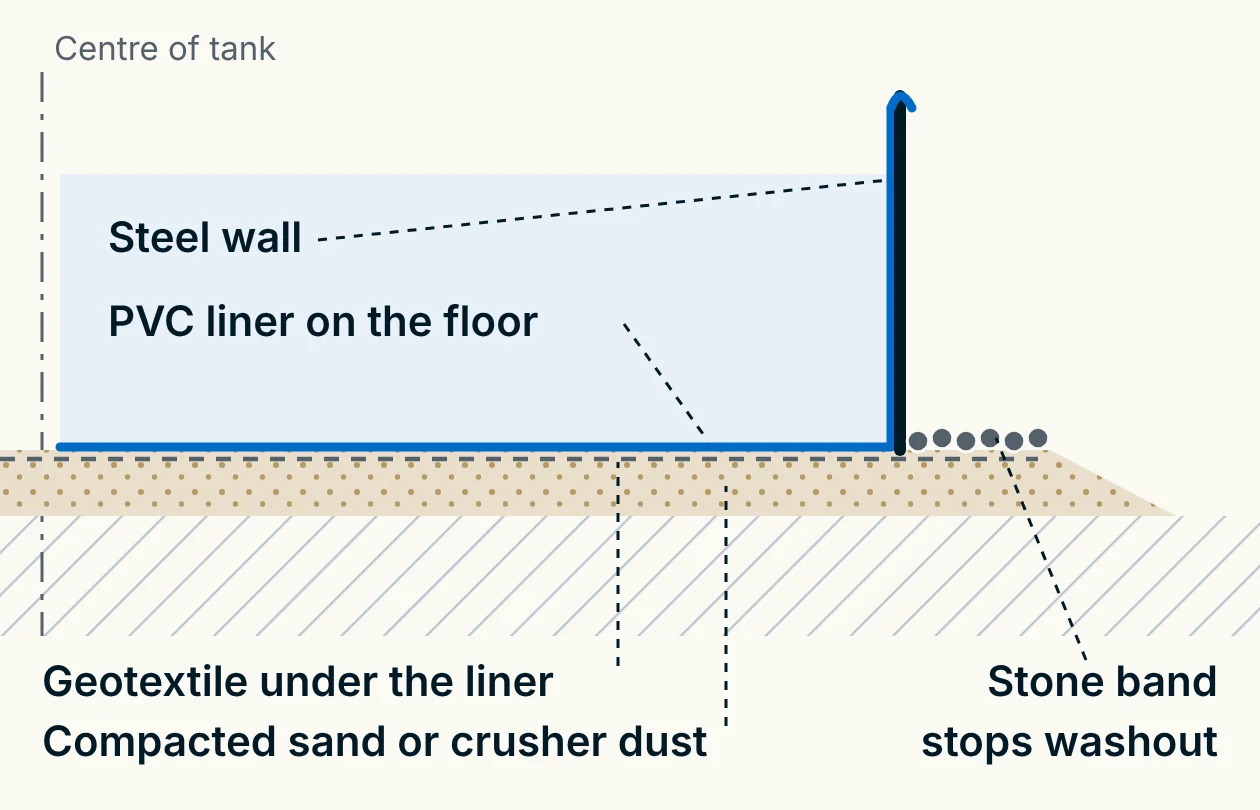
This is a flat, level platform of compacted sand, crusher dust or fine gravel, built a bit wider than the tank. Geotextile (a tough fabric) stops the fill mixing with the soil and protects the liner. The liner's floor sheet goes straight on top.
Good points
- Cheapest and quickest. It can be ready in a day or two with a plate compactor and farm labour.
- Soft on the liner. The fine surface is kind to the PVC.
- Drains well. Water does not stand under the floor.
- Easy to fix or move. You can re-level it or move the tank later.
Weak points
- The edge is the weak spot. Rain and overflow wash the edge away, and the sand spreads out under the wall over time.
- Nothing to bolt to. An empty tank, especially one with a roof, can be moved by strong wind.
- Only as good as the ground under it. On soft or problem ground it will sink unevenly.
- Needs looking after. You have to keep the edge topped up and protected.
Tip: hold the edge in with a ring of blocks or a steel edge, and put a band of stones around the tank so roof water cannot wash the pad away. It costs little and fixes the biggest weakness.
Best for: small and medium tanks on firm, flat ground in a sheltered spot.
Option 2: concrete ring beam
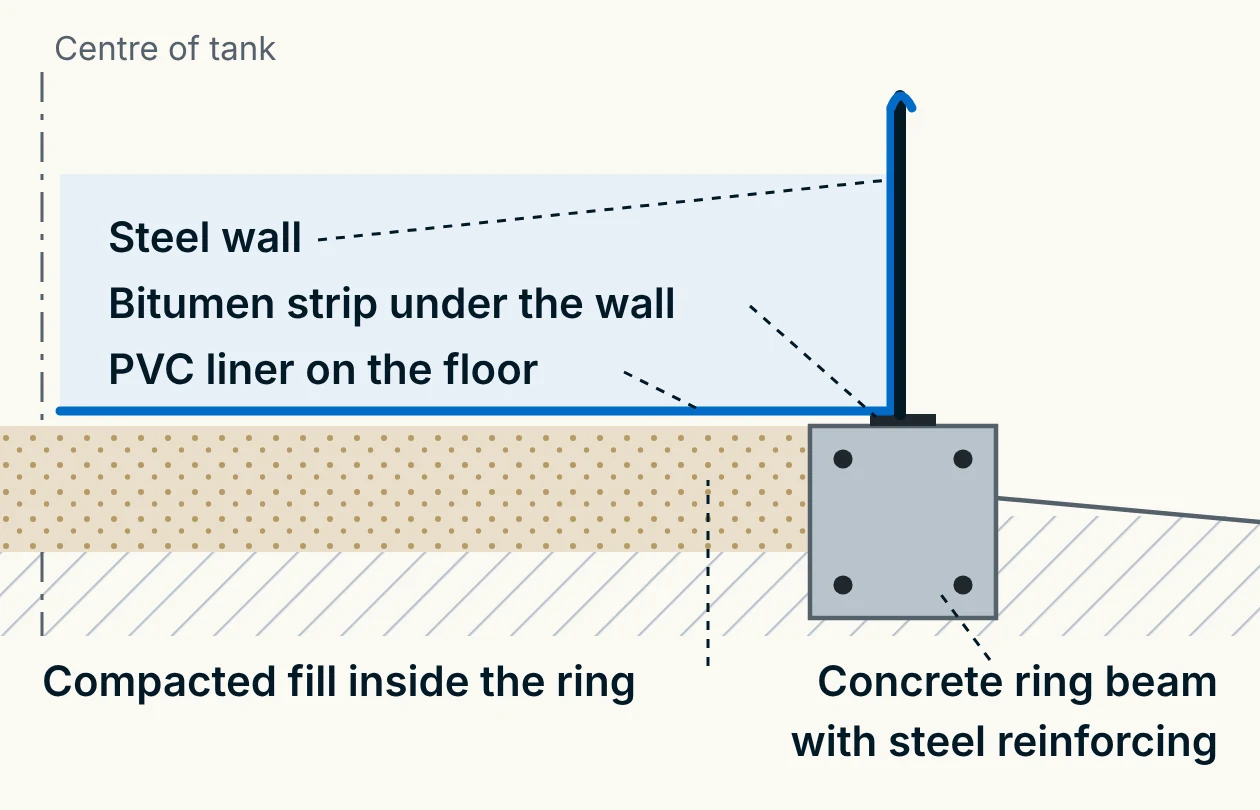
A ring beam is a reinforced concrete ring that sits under the tank wall, like a kerb in a circle. The inside of the ring is filled with compacted sand or crusher dust, and the liner lies on that.
Think of it as the best of both worlds. The concrete ring gives the steel wall a solid, level seat. The sand inside still gives the liner a soft, free-draining bed.
Good points
- The wall stays level. The ring gives a firm, accurate base to build the tank on.
- The edge cannot wash away. The ring holds the fill in place.
- Stops the edge sinking. The wall load sits on concrete, not loose sand.
- Something to bolt to. The tank can be anchored against wind.
- Keeps the bottom of the wall dry and up off the soil.
- Still kind to the liner, because the floor is sand, not concrete.
Weak points
- Costs more and takes longer. You need digging, steel, shuttering, concrete and about a week to cure.
- It must be built accurately. If the ring is not level or round, the tank will not be either.
- Does not fix bad ground in the middle. The fill inside can still sink if the soil under it is soft.
- The joint needs care. The joint between the wall and the concrete must be sealed and must shed water.
Best for: tanks from about 6 m wide and up, tanks with a roof in windy areas, sloping sites and sandy or coastal ground. For most larger farm tanks, this is the base we recommend.
How big should a ring beam be?
That depends on the tank size, the wall height and your soil, so there is no one size for all tanks. Large oil tanks overseas use rings at least about 300 mm wide, but a lined water tank puts much less weight on its wall, so the right size can differ. Your ring beam should be sized by an engineer for your tank and site. Damtech can advise on this when we quote your tank.
For worked-out sizes on firm ground, including the ring beam, the sand pad and the slab, see our guide to water tank base sizes.
Option 3: full concrete slab
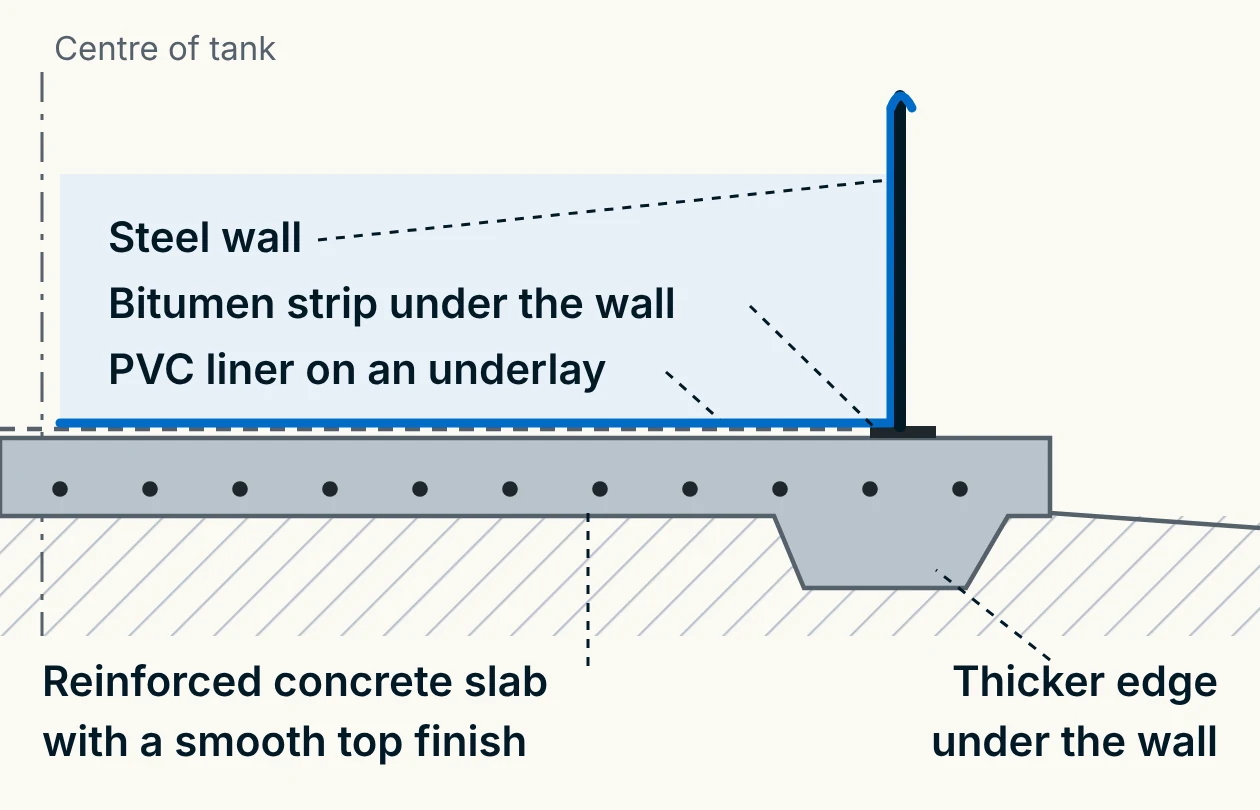
A reinforced concrete slab is cast over the whole footprint of the tank, usually a little wider. The wall stands on the slab, and the liner goes on a protective underlay on top.
Good points
- The strongest and most even base. It will not wash away, rut or sink at the edge if it is designed properly.
- You can see leaks. If the liner ever leaks, the water runs out at the edge where you can see it, instead of soaking into the ground. On some ground that is very important (see below).
- Anchors can go anywhere.
- Lowest maintenance over the life of the tank.
Weak points
- The most expensive option, and it needs a week or more to cure before the tank goes up.
- Must be smooth. A rough slab can wear through a liner, so it needs a smooth finish and a protective underlay.
- Thin slabs crack. The thin slabs used under small plastic tanks are not strong enough for a big steel tank. It must be designed for the full weight of water.
- Cannot be moved.
Best for: problem ground, drinking-water and fire-water tanks, and tanks close to houses, roads or slopes where a leak would cause damage.
Sand pad vs ring beam vs concrete slab: side by side
| Sand or crusher-dust pad | Concrete ring beam | Concrete slab | |
|---|---|---|---|
| Cost | Lowest | Medium | Highest |
| Time to build | 1 to 2 days | About a week, with curing | A week or more, with curing |
| Kind to the liner | Yes | Yes | Only with a smooth finish and underlay |
| Edge washes away? | Can do | No | No |
| Tank stays level | Fair | Good | Best |
| Can anchor against wind | No | Yes | Yes |
| Leaks visible | No, they soak away | No, they soak away | Yes, if detailed for it |
| Problem ground | Not suitable | Limited | Best starting point |
| Can be moved later | Yes | No | No |
| Best for | Small tanks, good ground | Larger tanks, wind, slopes, sand | Problem ground, drinking or fire water |
Which base for my tank size?
Use this as a starting point. Your ground can move you one column to the right.
| Tank | Firm, level ground | Windy with a roof, sloping or sandy | Dolomite, swelling clay or fill |
|---|---|---|---|
| 10 000 L (3 m × 1.5 m) | Sand or crusher-dust pad | Pad with a firm edge, or a ring beam | Concrete slab, with engineer's advice |
| 20 000 L (4 m × 1.5 m) | Sand or crusher-dust pad | Ring beam | Concrete slab, with engineer's advice |
| 50 000 L class (5 m × 2.3 m) | Pad with a firm edge | Ring beam | Concrete slab, with engineer's advice |
| About 6 m to 10 m wide | Ring beam | Ring beam | Engineered slab |
| Over 10 m wide | Ring beam | Ring beam, with anchors if roofed | Engineered slab or raft |
Not sure which size you need? Use our tank size calculator.
Your ground matters more than your tank size
In South Africa, the soil under the tank can change the answer completely. Check these before you choose a base.
Dolomite land (parts of Gauteng, including Centurion)
About a quarter of Gauteng sits on dolomite. Here, leaking water is the main cause of sinkholes. A water tank is a big source of water in one spot, so a leak into a sand pad on dolomite is exactly what you must avoid.
If your property is on dolomite land, find out its dolomite rating first (your municipality or a geotechnical report will have it), and get an engineer's advice. In most cases a concrete slab with a planned leak path, and rainwater led well away, is the safer base.
Clay that swells (black or "turf" clay)
Some clays swell when they get wet and shrink when they dry. A leaking or overflowing tank wets the soil on one side only, so the ground lifts unevenly and the tank goes out of level. On this ground, the clay is usually dug out and replaced, or a stiffened slab is used, with a concrete apron that sends water away from the tank.
Sandy, coastal and windy sites
Loose sand washes and blows away easily, so an open sand pad is not ideal. Use a ring beam, or at least a pad with a firm edge. On windy coastal sites, anchoring a roofed tank is worth it, and sea air means the steel and concrete at ground level need extra care.
Sloping sites
Do not build up loose fill on the low side to make a flat pad. It will settle and wash away. Cut a level platform into firm ground, and use a ring beam to hold the edge.
Galvanised or Aluzinc tank on concrete? Read this first
The steel at the bottom of the wall needs protecting on any base.
- Galvanised (Z275) steel is fine on fully cured concrete, but should not be set into wet, fresh concrete.
- Aluzinc steel should never touch concrete, even old concrete, if it can get wet. The alkaline concrete attacks the aluminium in the coating.
- On a ring beam or slab, put a bitumen separator strip under the wall and seal the joint so water runs off it.
- On every base, keep soil, stones, grass and weeds off the bottom of the wall. Wet dirt against steel is where rust starts.
Learn more in Aluzinc vs galvanised steel water tanks.
Water tank base checklist
Whichever base you choose, check these before the tank arrives:
- Clear the site. Remove topsoil, roots and plants.
- Compact the ground in layers. Never build on loose fill.
- Make it level. Check it across the full width in several directions.
- Make it wider than the tank, so the edge is not right at the wall.
- Finish with a smooth, fine layer with no stones or sharp bits.
- Protect the edge with a ring, blocks or a stone band.
- Slope the ground away from the tank so rain runs off.
- Pipe the overflow and drain well away from the base.
- Keep the bottom of the wall clear of soil and plants. Our guide to vegetation management around reservoirs explains why.
Frequently asked questions
Can I put a steel water tank straight on the ground?
No. Bare soil sinks unevenly, holds water against the steel and can have stones that puncture the liner. Always build at least a level, compacted sand or crusher-dust pad.
Is a ring beam better than a concrete slab?
For most larger farm tanks on normal ground, yes. A ring beam is cheaper than a slab, keeps a soft sand bed under the liner and still gives a solid, level seat for the wall. A slab is better on problem ground or where leaks must never reach the soil.
Is sand or crusher dust better for a tank base?
Both work when compacted properly. Crusher dust packs firmer and washes away less. Use a fine grade with no sharp stones, and put geotextile between it and the liner.
Do I need an engineer for my tank base?
For a small tank on good ground, usually not. For a large tank, a ring beam, a slab, or any site on dolomite, swelling clay, fill or a slope, yes. The base must be designed for your tank and your soil.
Is the base included in the tank price?
No. Damtech's tank kit prices exclude the base, delivery and installation. We can quote base work and installation separately.
How long does a base take before the tank can go up?
A sand or crusher-dust pad can be ready in a day or two. A concrete ring beam or slab needs about a week or more to cure first.
Get the right base for your tank
Damtech supplies and installs lined corrugated steel water tanks across South Africa. Send us your tank size, a few site photos and what the ground is like (sand, red soil, black clay, rock or fill). We will recommend the right base and quote the tank and installation.
Request a steel tank quotation or compare steel water tank sizes and prices.
This article is general guidance, not a foundation design. Every site is different, and the base for your tank should be checked for your soil, tank size and use.