Damtech guide
Water Tank Base Sizes: How Big Should a Sand Pad, Ring Beam or Slab Be?
How big should the base under a steel water tank be? For most of our lined corrugated steel tanks, the answer is one of three standard sizes: a 150 mm sand pad, a 300 × 500 mm concrete ring beam, or a 150 mm reinforced slab. This guide gives you those sizes, shows them on simple drawings and explains in plain language why they work.
Not sure which type of base you need? Start with our guide to choosing a sand pad, ring beam or concrete slab, then come back here for the sizes.
Quick answer: water tank base sizes
| Base | Use it for | Size |
|---|---|---|
| Sand or crusher-dust pad | Tanks up to 5 m wide, 1.55 m or 2.3 m high, on firm ground | 150 mm thick at the wall, rising 1:120 to the centre, 575 mm wider than the tank all round |
| Concrete ring beam | Tanks 6 m wide and up, and every 3.05 m high tank | 300 mm wide × 500 mm deep, 4 Y12 bars, top 150 mm above the ground |
| Concrete slab | Problem ground, or where a leak must show up quickly | 150 mm thick, Y10 bars every 300 mm both ways, 300 × 450 mm thicker edge |
| Hold-down anchors | Every tank with a roof, on any base | About one every 1.5 m round the wall |
These sizes are for firm ground. Soft clay, loose sand, dolomite, clay that swells and old fill all need a site-specific design. More on that below.
What these sizes are based on
We worked out the base for 25 common tank sizes, from 3 m to 17 m wide and 1.55 m to 3.05 m high. Each tank was checked full of water to the rim, and empty in a strong wind. The checks cover:
- Weight: can the ground carry the full tank?
- Settlement: how far will the floor and the wall sink, and will they sink evenly?
- Steel: how much reinforcing does the ring beam or slab need?
- Wind: can an empty tank blow over, lift or slide?
- Drainage: where do rain, overflow and leaks go?
The ground was taken as firm: soil that can safely carry about 10 tonnes per square metre (100 kPa), such as dense sand or stiff clay. Wind was taken as 36 m/s, which is the design wind speed for many South African towns. If your site is softer or windier, the sizes change.
Why the water sets the size
A full tank holds far more water than it weighs in steel. A 10 m × 2.3 m tank holds about 181 tonnes of water, but its steel wall and roof weigh only about 2 tonnes. So the base is sized for the water.
How hard the water presses down depends only on how deep it is, not on how wide the tank is:
| Tank height (full) | Pressure on the base | Weight on each square metre |
|---|---|---|
| 1.55 m (two rings) | 15.2 kPa | About 1.5 tonnes |
| 2.3 m (three rings) | 22.6 kPa | About 2.3 tonnes |
| 3.05 m (four rings) | 29.9 kPa | About 3 tonnes |
Firm ground carries that easily. Even the heaviest case, a 3.05 m tank on a ring beam, uses less than 40% of what firm ground can safely take. Strength is not the problem. The edge, the level and the drainage are. That is why each base below is sized for those jobs.
Sand pad size
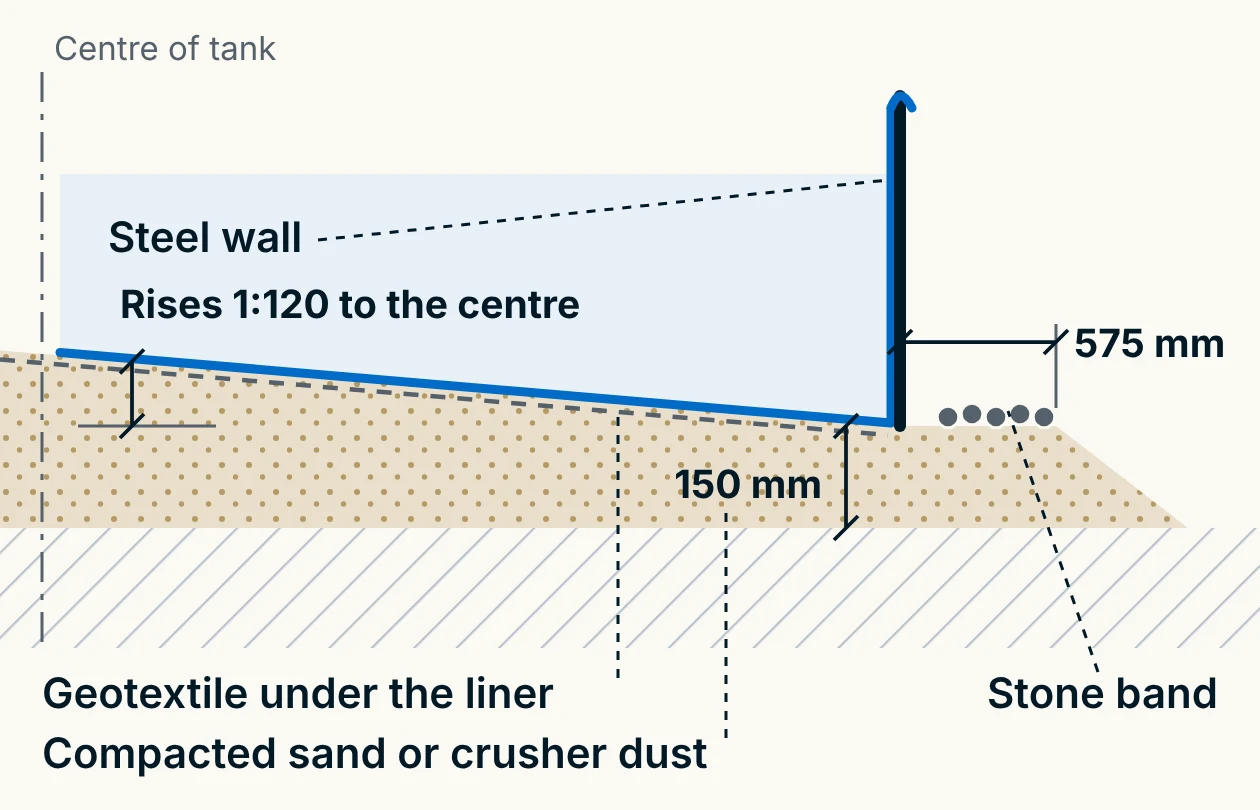
- Thickness: 150 mm of compacted sand or crusher dust at the wall. If the topsoil is deeper than 150 mm, dig it all out and make the pad thicker by the same amount.
- Fall: the top rises 1 in 120 from the wall to the centre. On a 5 m tank, the centre is about 21 mm higher than the edge.
- Width: the pad runs 575 mm past the wall all round. A 5 m tank needs a pad about 6.15 m across.
- Edge: a 400 mm band of stone past the wall stops rain and overflow washing the pad away.
- Under the liner: a geotextile protection layer, on a smooth surface with no stones.
Why 150 mm and not thicker? A thicker pad does not spread the weight any better. The water already presses evenly over the whole floor. The pad's real job is to replace the soft topsoil, give the liner a smooth and level bed and drain any water to the edge. 150 mm is one well-compacted layer.
Why the fall to the edge? The middle of a full tank sinks a little more than the edge. The 1 in 120 fall is bigger than that dip on every tank we checked, so the floor still drains towards the wall, where you can see a leak.
Why 575 mm past the wall? The weight of the wall spreads out as it goes down into the pad. The extra width keeps that load inside compacted material, with room for the stone band.
Why stop at 5 m? On bigger tanks the pad's weak spot is the edge, not the weight. A bigger roof sheds more rain onto the edge, a bigger footprint is more likely to cross a soft patch, and a sand pad gives you nothing solid to bolt anchors into.
Ring beam size
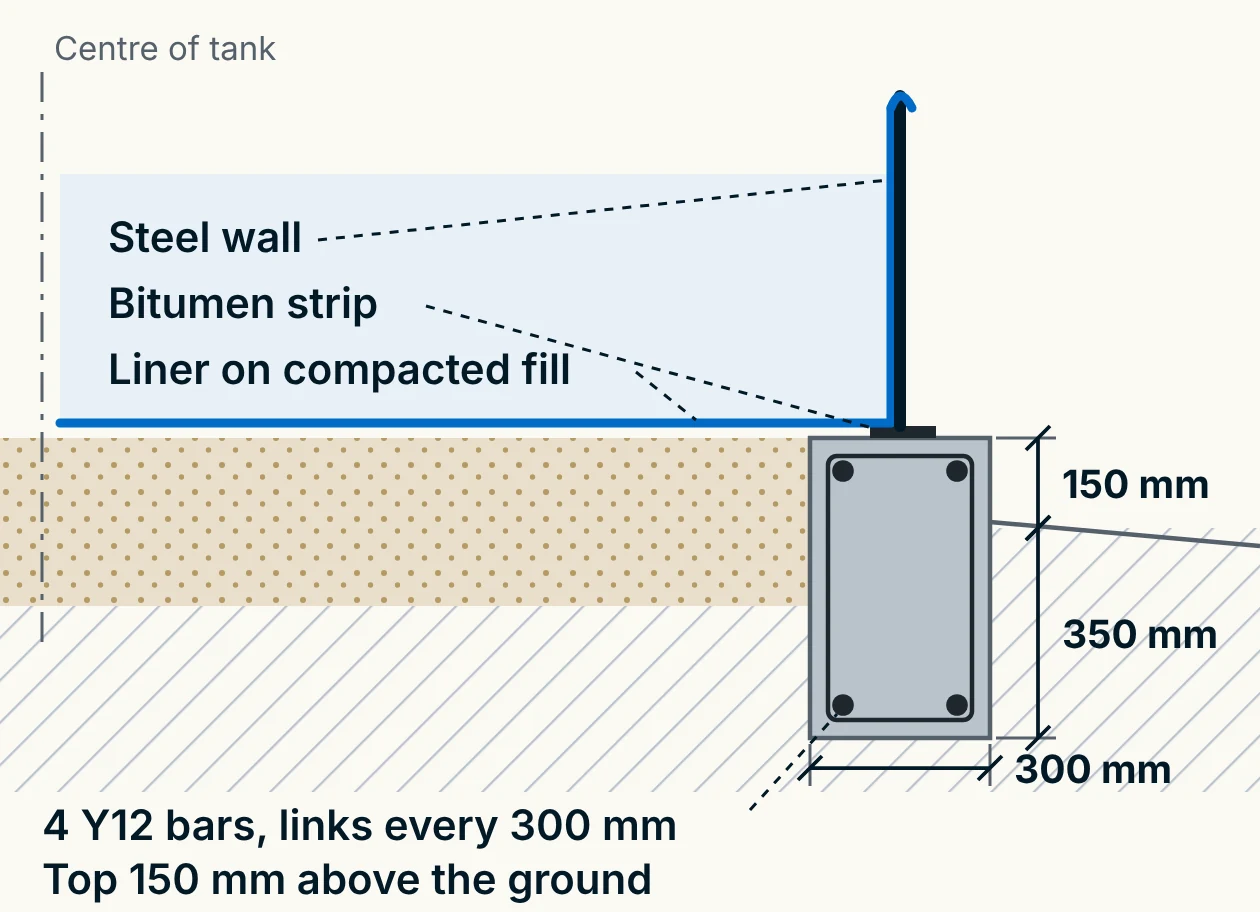
- Size: 300 mm wide × 500 mm deep, with the top 150 mm above the ground and 350 mm below it.
- Steel: 4 Y12 bars running round the ring, one in each corner, held by links (R8 or Y8) every 300 mm.
- Concrete: 30 MPa, with 50 mm cover to the steel.
- On top: a bitumen strip under the steel wall, so the wall never sits directly on concrete.
- Inside the ring: compacted sand or crusher dust, with the same 1 in 120 fall and a geotextile under the liner.
One size fits every tank from 3 m to 17 m wide. That may sound odd, but here is why.
The fill inside the ring pushes outwards, and the ring holds it in like a hoop round a barrel. On the biggest tank we checked, that push needs less steel than the minimum any concrete beam should have. So the minimum steel decides the size for every tank, and four Y12 bars cover all of them.
The ring also presses on the ground almost exactly as hard as the water and fill next to it, within about 25%. That means the wall and the floor settle together, which keeps the wall round and level. A much wider ring would press less, settle less than the floor and pull the liner at the edge.
Why 300 mm wide? That is the smallest ring width used in international tank practice. It also leaves room for the wall, the bitumen strip and enough concrete cover over the steel.
Why 500 mm deep? The 350 mm below ground gets through the topsoil to firm ground. The 150 mm above ground keeps the bottom of the steel wall dry. On poorer ground, make the ring deeper, not wider.
Concrete slab size
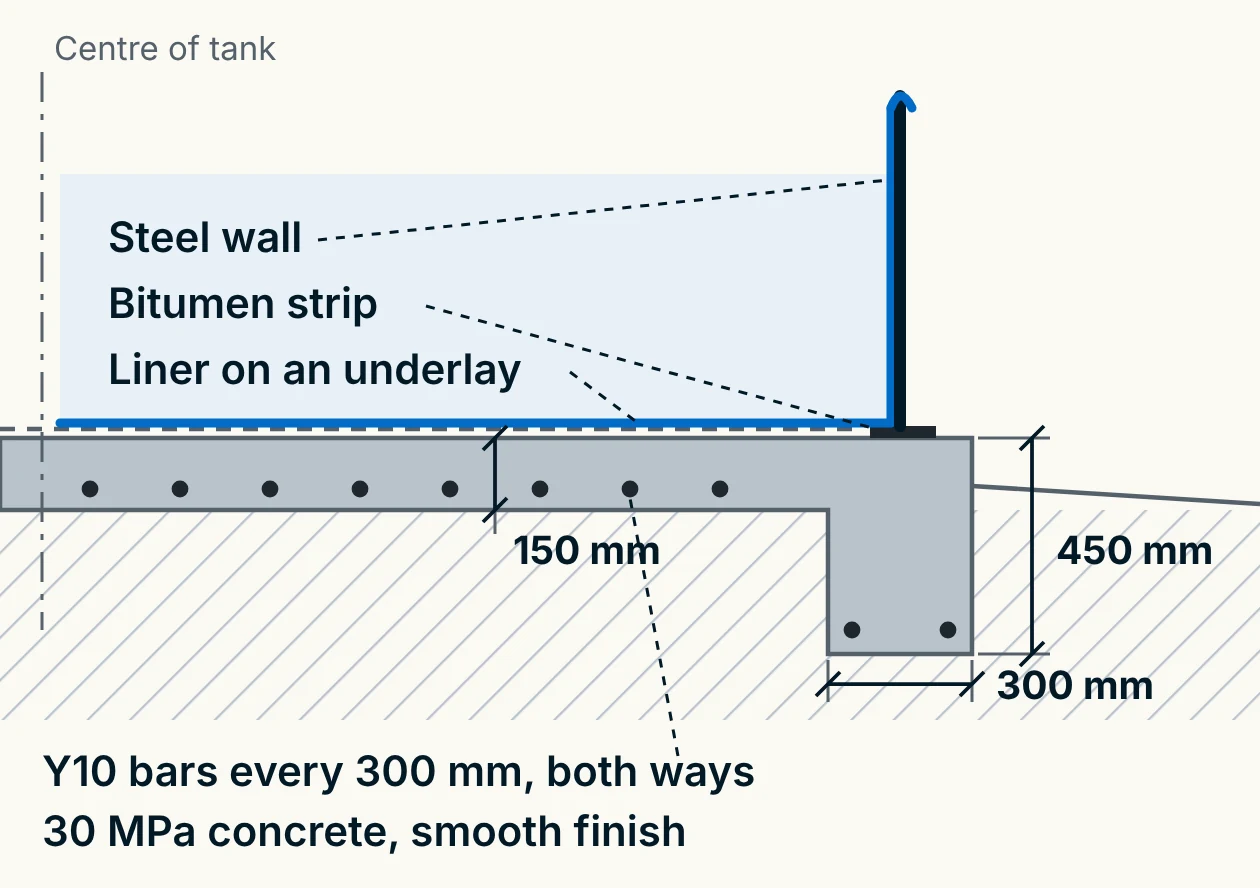
- Thickness: 150 mm of 30 MPa concrete with a smooth, steel-trowelled top.
- Steel: Y10 bars every 300 mm both ways, near the bottom of the slab.
- Edge: a thicker edge 300 mm wide and 450 mm deep under the wall.
- On top: a bitumen strip under the wall and a protective underlay under the liner.
Why 150 mm? On even ground a slab under water hardly bends at all. It only works hard where the ground under it gives way, such as a soft pocket or a washout. This slab can bridge a soft spot 1.2 m to 1.6 m wide, depending on the tank height.
Do not use a thin slab. The 75 to 100 mm slabs with mesh that are often shown for plastic tanks are too thin and too lightly reinforced for these tanks.
A slab is not a dolomite design. On dolomite land, a foundation may need to span a sinkhole of 5 m or more. That needs a much deeper, heavily reinforced raft designed for that site.
Which base and size for my tank?
| Tank width | Tank height | Base on firm ground |
|---|---|---|
| 3 to 5 m | 1.55 m or 2.3 m | Sand pad, 150 mm |
| 6 to 17 m | 1.55 m or 2.3 m | Ring beam, 300 × 500 mm |
| 3 to 14 m | 3.05 m | Ring beam, 300 × 500 mm |
| Any size | Any height | Slab or engineered raft on dolomite, clay that swells, old fill or very soft ground |
A ring beam also suits small tanks with a roof in a windy spot, because it gives the anchors something solid to hold.
How much sand and concrete will I need?
These amounts depend only on the tank width. Order about 10% extra for waste.
| Tank width | Sand pad fill | Ring beam concrete | Slab concrete |
|---|---|---|---|
| 3 m | 2.1 m³ | 1.4 m³ | 2.4 m³ |
| 5 m | 4.6 m³ | 2.4 m³ | 5.1 m³ |
| 6 m | Use a ring beam | 2.8 m³ | 6.8 m³ |
| 8 m | Use a ring beam | 3.8 m³ | 11.0 m³ |
| 10 m | Use a ring beam | 4.7 m³ | 16.1 m³ |
| 12 m | Use a ring beam | 5.7 m³ | 22.1 m³ |
| 14 m | Use a ring beam | 6.6 m³ | 29.1 m³ |
| 17 m | Use a ring beam | 8.0 m³ | 41.3 m³ |
The ring beam figure is the ring only. You also need compacted fill inside the ring.
Hold-down anchors: every roofed tank needs them
This surprises most people. A full tank is heavy, but an empty tank is very light. A 10 m tank weighs about 2 tonnes empty. In a strong wind, the suction on its roof can lift far more than that.
In a 36 m/s wind, every empty roofed tank we checked could lift, tip or slide unless it was anchored. Tanks without a roof can slide too. And the water does not help: in a lined tank the water sits on the liner, not on the steel, so it does not hold the wall down.
| Tank width | Anchors (about 1.5 m apart) | Pull on each anchor |
|---|---|---|
| 3 m | 7 | 2 to 5 kN |
| 5 m | 11 | 3 to 4 kN |
| 7 m | 15 | 4 to 5 kN |
| 10 m | 21 | About 6 kN |
| 14 m | 30 | About 8 kN |
| 17 m | 36 | About 10 kN |
Anchors are bolted into a ring beam or slab, which is one more reason to choose them for roofed tanks. On a sand pad you need ground anchors. The anchor, the bracket and the wall connection must be designed together for your tank.
How much will my tank settle?
- On firm ground: less than 20 mm in the middle, and the middle dips less than 7 mm more than the edge. The liner barely notices.
- On soft ground: up to about 76 mm in the middle and a 28 mm dip. That is still inside the 1 in 120 fall, but soft ground is rarely even, so one side can sink more than the other.
- On clay: clay keeps settling slowly for months or years after the tank is filled. That needs a soil test.
Drainage around the base
- Shape the ground to fall away from the tank, about 1 in 50 for the first 1.5 m.
- Never let water stand against the bottom of the wall or the ring beam.
- Lead the overflow and scour pipes a few metres away, onto stone or concrete, never onto the pad edge.
- On bigger roofed tanks, fit gutters with a pipe to a safe outlet. A 17 m roof sheds about 6 litres a second in a heavy storm.
Worked example: 10 m × 2.3 m tank
- Water: about 181 tonnes, pressing 22.6 kPa on the base.
- Base: a ring beam, because the tank is wider than 5 m.
- Ring beam: 300 × 500 mm with 4 Y12 bars, about 4.7 m³ of concrete.
- Fill inside the ring: compacted crusher dust, rising about 42 mm from the wall to the centre.
- Settlement on firm ground: about 10 mm in the middle, with less than 4 mm dip compared with the edge.
- Anchors (roofed tank): about 21, each taking about 6 kN.
When these sizes do not apply
Get the base designed for your site if any of these are true:
- The ground is soft clay, loose silty sand, old fill or clay that swells and cracks.
- The site is on dolomite.
- The site slopes, or part of the base is on fill.
- Your area has a design wind speed of 40 m/s or more.
- The tank is wider than 17 m or taller than 3.05 m.
- The tank holds drinking or fire water where a failure would put people or property at risk.
Frequently asked questions
How thick should a sand pad under a water tank be?
150 mm of compacted sand or crusher dust at the edge, rising 1 in 120 to the centre. Dig out all topsoil first. If it is deeper than 150 mm, make the pad thicker by the same amount.
What size ring beam does a 10 m water tank need?
On firm ground, 300 mm wide and 500 mm deep with 4 Y12 bars. The same ring suits every tank from 3 m to 17 m wide, because the minimum steel decides the size, not the tank.
How thick should a concrete slab for a water tank be?
150 mm with Y10 bars every 300 mm both ways and a 300 × 450 mm thicker edge under the wall. Thinner slabs with mesh are not suitable for steel tanks.
Does a bigger tank need a bigger ring beam?
Not on firm ground. A wider tank puts more water on the base, but the pressure per square metre stays the same for the same height. A bigger tank needs a longer ring, not a bigger one.
Do steel water tanks need to be anchored?
Every steel tank with a roof needs hold-down anchors, because an empty tank is light enough for strong wind to lift or slide. Water in a lined tank does not hold the wall down.
Get the right base for your tank
Damtech supplies and installs lined corrugated steel water tanks across South Africa. Send us your tank size, a few site photos and what the ground is like, and we will confirm the base and its size with your quote.
Request a steel tank quotation, compare steel water tank sizes and prices or work out the tank size you need.
The sizes in this article were worked out for firm, even ground (100 kPa safe bearing), a 36 m/s design wind and Damtech's standard lined corrugated steel tanks. They are a starting point, not a design for your site. Soft, variable or problem ground, dolomite and high-wind areas need a site-specific design.
Calculations checked and signed off by Tiaan de Lange, Pr.Eng (ECSA reg. no. 202504039), 12 November 2026.